I have always been a vivid dreamer. At night, my mind could, and still can, conjure up the wildest stories, which I can mostly recall the morning after. Unfortunately, this ability extends to nightmares as well. And while I rarely have those now, I used to dream up all kinds of horrors when I was little. What made those dreams worse was waking before daybreak, when my room was still shrouded in absolute darkness. I’d wake up freezing and sweating at the same time with my body and blanket tossed about the mattress. My chest would clench and I’d wrap myself back into the blanket and curl up into the tiniest form I could physically make. Then, I’d close my eyes and hope for sleep even through I’d be wide awake at this point. I’d try not to think about what I had just dreamt but obviously that was futile. The more I’d try to steer my brain away from it, the clearer the memory burned in my mind’s eye. By that point, my body would feel too heavy to move, paralysed by the fear that if I’d open my eyes, something would be staring back from the dark. I’d suddenly be hearing all the creaks and groans made by my childhood home and my brain would try to convince me that it was a person – or worse – roaming about my room. And when I’d eventually do open my eyes, I’d be greeted with the sight of my room, but not quite my room. More like a stretched, shadowy version of it, a warped mirror of what I see at daytime. I’d need what always felt like hours to unfreeze my body and, in a quick, split-second move, turn the nightlight on, as if the speed would wade off any invaders. Only then, I’d finally begin to calm down. Nowadays, I immediately turn on the light and grab my phone or any other object to distract me, but back then I would always be paralysed by this heavy, all-encompassing feeling, where my entire body tenses up and everything around me seems so out of place that it scares me. Watching Skinamarink managed to remind me of that same exact feeling.
This film was certainly something. I hadn’t really known what to expect from it, which might be because this was my first non-slasher horror movie. I am pretty sure someone with more expertise in this field would have advised me against starting with Skinamarink but it’s too late for that now and at least I had company watching it. That company being my friend Carlos, who has not only saved me from consuming that film in solitude, but who also has a better understanding of movie making and aesthetics than I do. To be frank, I found the first 15 to 20 minutes of the movie rather boring – in a bad way, but in the sense where it felt like there wasn’t much going on – however by the end, I had a pillow clutched to my chest in a desperate attempt to not cover my eyes with it. Both Carlos and I went from goofing off to being fully absorbed by the happenings on screen in a matter of mere minutes, and this film ended up being one of the most uncomfortable and scary things I have ever watched. And I want to know how Skinamarink did that!
Now, this movie is the closest thing to mainstream that analog horror has and the opinions on it are quite divided. Some love it, some hate it, and I understand that this is a very vague sentence to say but Skinamarink is truly unlike anything I’ve ever watched, so I understand why opinions may differ. This movie is not exactly narrative-driven in the traditional sense, but rather atmospheric. I had already read that I needed to sit and wait and let myself get into it beforehand, and so I did. Understandably, that may not be for everyone, but to me, it certainly had been worth it, so now I get to tell you about my findings.
Let’s start off with the question: What is Skinamarink? It is a 2022 indie film made by the Youtuber Kyle Edward Ball. Before Skinamarink, Ball worked on his YouTube channel named “Bitesized Nightmares”, where he would take comments of his viewers on (childhood) nightmares and turn these into short horror films. A similar motivation brought forth Skinamarink. Another inspiration for the film was the (in North America) popular children’s sing-along song Skidamarink, that is the movie’s namesake, just with a few letters changed, so children that google the song wouldn’t accidentally end up finding the movie.[1] Just a little fun fact that I found quite considerate of Ball. It just goes to show how much thought he put into his project. Skinamarink itself falls into multiple genres that overlap, but mainly experimental horror and, of course, analog horror. Though that latter part may be a bit of point of discussion, as I have found.
There is the argument that while the film is conveyed through an analogue lens, this lens itself is not meddled with, as is customary in analog horror. I would like to argue that this may be the case, but that there is an instance of an analogue device being corrupted. One that is actually vital to the film, as it acts like a parallel to the events of the plot: the VHS tapes. The entity of the movie can freely corrupt them if it wishes to do so. As I will further explain in the coming paragraphs, this too replicates the instance of twisting nostalgia by interfering with the tapes. Apart from that, the movie ticks off almost all the boxes of the characteristics typical for analog horror (which you can find in one of the previous entries of this blog). For example, there’s a voyeuristic nature to the film, perhaps not through the entirety of it, but it plays a big role in the scare-factor. Furthermore, the horror is progressive. It builds in layers, constantly keeping the audience on its toes and guessing. By the definition established for this blog, there are more arguments speaking for this film belonging to analog horror than against. Plus, Ball has commented on the inspirations he took from the genre. That is more than enough to qualify Skinamarink for its inclusion into this genre.
As for the production itself, the film was made with a budget of just $15,000, most of which was crowdfunded. With such a small budget, Ball and his team had to get creative in certain departments, which is only one of the reasons as to why the project was filmed in Ball’s childhood home. Eventually, the finished film premiered at the 26th Fantasia International Film Festival in Montreal on July 25th 2022 and was played at some more festivals afterwards, until at one of these festivals, the film got pirated and clips got leaked on different social media platforms like TikTok or Reddit. (A small reminder here to support your small and indie creators and not to do stuff like that. It ended well for Skinamarink, but that’s not necessarily the norm.) In any case, the positive reception eventually did help the film get into theatres, where it made about $890,000 on the opening weekend alone.
Before we move on to the plot summary, I’d like to give you a spoiler warning and encourage you to watch the film yourselves. But truth be told, I don’t think that knowing the plot of the movie takes away from the experience. Even now that I have combed through multiple analysis videos and comment sections, I am still not entirely sure what is going on in this movie. Like, in a vague sense, I do know what is going on, but not entirely. I promise that’ll make sense later.
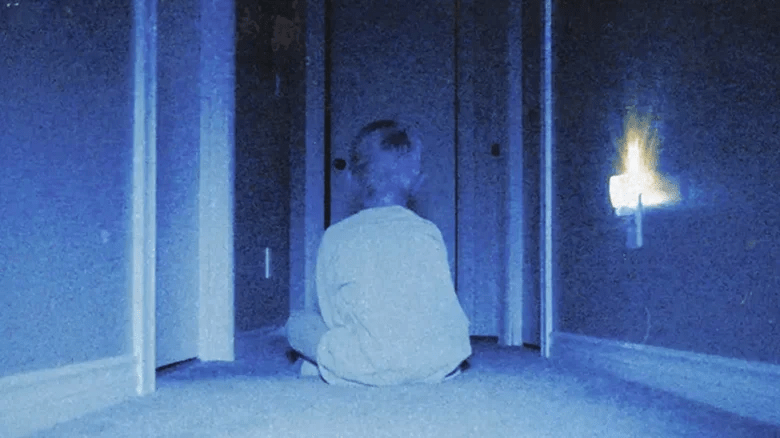
The official plot summary of this movie on the website is: “Two children wake up in the middle of the night to find their father is missing, and all the windows and doors in their home have vanished. […]”[2] These two children, named Kaylee (aged six) and Kevin (aged four), then go on to create a sleepover-like camp in the house’s living room and try to pass the time and wait until their father, or any other adult really, returns. Two things become clear rather quickly: Firstly, the children are not alone in the house, and this other presence is not having their best interest in mind, and secondly, the children sense that something is wrong but they do not know what to make of the situation. They are simply too little to understand the stakes. That’s ultimately the tragedy of Skinamarink. The audience can merely watch as the entity, or whatever this other presence is, lures these children into different corners of the house and torments them in increasingly graphic manner. Ultimately, Kaylee and Kevin get stuck in what seems to be a time loop of infinite torture with seemingly no way out, which is bad enough when it happens to adults, but here the victims are children who are completely helpless. That makes us as the audience feel much worse about their fate. Heck, these kids aren’t even tall enough to reach a light switch. That’s why the majority of the film plays out in almost total darkness, or, at best, illuminated by a flashlight.
There are a handful of other information that I consider relevant to the plot as well. The film begins with Kevin seemingly playing hide-and-seek by himself before he falls down the stairs and hits his head. From a phone call the father makes (which I presume to be with the mother), we learn that he didn’t need stitches and that Kaylee claims to have seen her brother sleepwalk. Another important figure in the film is the mother. From the movie summary, we learn that the father disappears. Despite one of Kaylee and Kevin’s conversations, in which we learn that their mother left in some way, she keeps appearing throughout different scenes, never facing the children, or us as an audience, directly. From the same conversation, we learn that Kaylee doesn’t wish to speak of their mother, somewhat implying that there is a whole separate situation going on with her that is not further detailed within the film.
Apart from the plot, there are some other characteristics worth emphasising about the film. The footage we watch is grainy and alternates between weirdly cut off shots of the rooms, where only parts of the children or close ups of objects are shown, and first-person segments. In the latter case, the audience is placed in the shoes of the children as they walk around the dark house, which makes it look a bit like a found footage movie from a child’s perspective. Even more so when paired with the sometimes indistinct audio, which oftentimes requires subtitles to be understandable. The dialogue generally happens off screen or in a way that you cannot tell who is talking if the voices aren’t audible enough.
Apart from that, there are many ambience shots where we see parts of the wall that fade into shadow or the kids’ toys on the floor. There is most noticeably a contrast between the seemingly endless darkness of the house’s corners and corridors and the bright glow of the TV screen, like a fenced off area of light in which the children are safe, and the scary darkness around it. The shots of this darkness and the bright areas that bleed into it are drawn out as well. While watching an analysis video about the movie on YouTube, I found a comment concerning these shots. Here, the commenter details how the length of these shots works with the horror of the film, as it forces the audience to sit through the discomfort of not knowing whether something is truly lurking in the dark or not.[3] I feel like that comment perfectly captures it. While Carlos and I had the opportunity to stop the movie (which we barely did, proud of myself here), someone watching it in cinema would have had to sit through it. In a sense, the audience is forced through the same feelings the children might have perceived in that same situation.
All these things combined produce an end result that almost feels like perceiving a dream or a fuzzy memory. The house and actions of the children are familiar enough to relate to, yet the whole situation and predominant darkness keep you from getting too comfortable. This may sound familiar, as it is another case of tapping into nostalgia only to corrupt it for the fear factor, which leads us to the next question: How does horror look like in Skinamarink?
There are four distinct aspects that come together to create the horror of Skinamarink, namely: the play on the fear of the unknown, the intrusion into familiarity, the perspective, and the suffering through the lens of a child. Let us start with the play on the fear of the unknown. Or rather, let’s return to the thought of the previous paragraph: the house is almost entirely devoid of light. In fact, if it wasn’t for the children keeping on the TV or using flashlights, we wouldn’t be seeing much of anything. After all, there are no doors or windows to let light in. But we as the audience are very much aware that there is something inside that house with the children. Thus, every shot pointing into darkness might as well be a shot at something lurking within it. There are two elements contributing to this: the indistinct audio as well as sometimes unassignable voices, and the fact that a lot of the actions in this movie are not happening directly on screen. Instead, they are implied by audio cues or before and after shots. The viewer’s mind is forced to fill those gaps. In other words, we know that there is something lurking in the dark and roughly know what is happening, but never to what extent. The viewer is left wondering or, as in my case, fearing that there is always more to shots we are shown than what can be perceived at first glance. That’s what makes the slow pacing so uneasy to watch.
One specific scene that showcases this effect is when Kevin, left all alone after the entity took Kaylee, goes upstairs with his flashlight. On the upper floor, the house tilts, forcing him to walk on the ceiling until he reaches an open door. Here he begins turning the light on and off and I began bracing for a creepy face or something similar every time the light turned back on. But even after the third time, nothing happened and I made the foolish mistake of letting my guard down – because the face appeared after he turned the light back off again. I won’t lie that was probably the worst scene for me to watch because I knew something was going to happen, but I didn’t know what exactly or how, so it still caught me off guard. And that is something this movie does well. It makes you fear something you can’t quite grasp, so you look for it in every corner and still, it is always the wrong corner.
Moving on to an aspect of horror we have talked about in previous entries of this blog (almost as if it’s a pattern in analog horror): the intrusion into familiarity. When most of us think of our homes, whether this includes a whole house, an apartment, a singular room, or even just the specific corner of a room, we think of comfort and safety. It is a place of refuge in opposition to the potentially dangerous, at the very least stressful, world outside. Ideally, we know every corner of our home and are in charge of it. But what happens if these circumstances cease to be? Skinamarink works with that exact idea. Something enters the house and takes full control of it, eradicating any sense of comfort and security in it. At the same time, any way to the outside world, where these children would be safe from the entity, disappears. While it is technically still the same house, it stops being a safe place for Kaylee and Kevin the second the entity appears. Not only, because the entity has all kinds of abilities and thus full control over the house, but also because it specifically targets the children as the household’s residents most reliant on adult or other outside help. That exact help is not here anymore. The entity makes sure of it by taking this type of comfort away as well. The father disappears, the mother or her image (we can’t really be sure here) are demonised and used to torment the children further, and Kaylee and Kevin are ultimately left to the mercy of that entity. It goes as far as that when Kevin hides under his blanket in fear, an action most of us are familiar with, as blankets are basically the epitome of warmth and comfort, the entity somehow forces him out of that safety, leading to him being forced to stab his eye out. Every shred of comfort is ripped from these children and we as the audience are forced to watch it happen.
Actually, we are not just watching it happen, we are a part of it. Another element that makes this film so scary is the fact that when the first-person shots occur, the audience is essentially put into the roles of the children. When Kaylee or Kevin move, so do we, and that is especially accentuated by having the first-person view on child-level. The audience suddenly turns into Kevin, who has to climb an impossibly high flight of stairs, or Kaylee, who by use of her father’s voice is coerced into looking into the pitch-black darkness underneath her father’s bed, twice (!). Horrifying scene by the way. That is the reason I do not have a bed you can look under.
Being suddenly forced into that perspective whenever action occurs plays well into having the audience sit with the anticipation of something happening and the discomfort of not knowing what. On an emotional level, the audience is basically put through the same as the children. We are being made helpless by being put into the role of someone who doesn’t know better and can’t actually do much anyways. This is yet another big element of the horror in Skinamarink: the manipulation and gruesome torture that happens in the film affects two helpless children. Again, Kaylee and Kevin are six and four years old. Kaylee might have barely started elementary school. Half the appliances and switches in the house are too high for them to reach. Their first instincts are to go to their parents for help because on their own they really have no idea what is going on or how to navigate the situation. At some point, they do grasp that something is very wrong, but if the adult watching the movie can’t understand the full extent of what is going on until far too late, how are these children expected to do so?
Eventually, Kaylee and Kevin realise that they are on their own and that they will have to wait it out until someone appears to help. So, what do they do? They pass the time in doing things that they find comfort in. Except, we have already established that there is no comfort for these children. Everything that helps them to go on is eventually taken from them. The old cartoons they watch on VHS tapes? They get corrupted by the entity and the TV ends up playing the same scene of a bunny making itself disappear in a loop. The cozy little sleepover camp they have built for themselves is eventually invaded by the entity after it manages to separate the children. All the Lego builds, drawings and plushies the children have made to distract themselves are violently yeeted (for the lack of a better word) onto the ceiling and adjacent walls or made to disappear entirely.
Another way in which the children pass the time is by taking care of their needs. They bring out a little cooler with juice and snacks and grab a box of cereal. Without milk, I’d like to add, because they likely can’t reach the fridge to get it. Needless to say, the audience comes to realise that this is only a temporary solution to the children’s hunger and thirst. But that isn’t where the entity interferes. Another issue the children have is that they are scared to go upstairs, so they use the downstairs bathroom. But at some point, Kevin calls out for Kaylee to have a look at something and we find out that the toilet has disappeared. I feel so bad for laughing at this scene. While watching it, it seemed so insanely absurd: Why would a poltergeist (our leading theory at that point of the film) steal a toilet? Well, I got the answer to that about a second later when the children are forced to use the bathroom in the very dark and very creepy upper floor. The smile was immediately wiped off my face.
One remarkable aspect about these children is that every scene in which they are together makes it clear they are siblings. They stay together at almost all times. Kaylee is with Kevin when he needs to use the upstairs bathroom. Kevin tries to console his sister after she returns visibly shaken from a solo trip to the upper floor. They play together, they eat together, they take care of each other. It is absolutely heart-warming to watch them be so sweet to one another. Near the beginning, after they have made their little sofa fort, Kaylee and Kevin tell each other that they love the other, which is so cute and made me hope that everything would work out well for them. Then, after the film, when I turned to the internet for more opinions, I learned that this scene should have been moment for me to realise that they were doomed. These kids have no one left but each other and it is clear that they find comfort in this company. It is only after the creature manages to lure them apart that things take a turn for the worse. A graphic worse. As the audience, it really feels like watching each layer of comfort being stripped away until these children, specifically Kevin in the end, have nothing left but fear and suffering. The whole movie really feels like an inescapable nightmare, slowly unfolding until every bit of childlike innocence is torn from these siblings, until they are broken and weary. Their fate is sealed with Kevin’s tired: “Can we watch something happy?”[4] Experiencing the film through the perspective of these two children doesn’t just make it terrifying, but ultimately a very sad story to watch.
All these observations aside, I am left with one question: What exactly is Skinamarink about? How are the happenings in this film to be interpreted? It feels like each scene brings more questions than answers. Well, there are multiple approaches to the film. One interpretation follows the idea that Kevin has suffered serious brain trauma after his fall and the happenings of the film are simply the outcome of a dream or of Kevin being in a coma, hence the continuation of the loop they are in. The “572 days”[5] emphasised in the movie might actually relate to the number of days Kevin has been in a coma. Personally, I am not a fan of that trope. It feels too much like a quick fix for me and oftentimes nullifies the events within the story in some way. That’s why I am glad that the movie didn’t have an ending that outright points into that direction. It is still a possible interpretation, but I choose to ignore it.
One possible reading, which Carlos pointed out early on during our watch, was that this movie is an analogy for a traumatic childhood in an abusive home. Maybe in the context of the parents divorcing, which could explain why the mother is ‘gone’. Upon reading through various comment sections, I stumbled upon many others that came to the same conclusion, citing that the whole idea of the children not being able to escape resonates with the feeling of being stuck in an abusive home with no way out. One comment in particular stuck with me. It referenced the scene in which Kevin, after stabbing his eye, finally decides to call the police, only for the entity to turn the phone into a toy phone mid-call. This scene could represent a child asking for outside help, only for the parent to intervene and cut off another channel that could potentially help the child escape the abusive home.[6] The unreliability of the parent(s) might as well be another reason why the siblings are so close, as they only have each other for support in this situation.
Yet another pointer for this theory could be the trailer of the movie. That might be a bit of a stretch but hear me out. In the trailer, the phrase “In this house”[7] is repeated continuously. I immediately had to think of the Adult Swim infomercial This House Has People in It, or more specifically, a comment I had seen about this video. It is a house with people in it, not a home with a family in it. Skinamarink’s trailer might be working with this play on semantics. This association certainly made me believe in this theory before all else.
Another possible interpretation that is similar to the previous one, but definitely stuck with me, is that Skinamarink showcases the downward spiral into neglect and suffering of a family in which the mother killed herself. The idea here is that the father could not cope with losing the mother and thus Kevin and Kaylee are forced to rely on themselves and each other. This theory stems from the specific scene in which Kaylee is in her father’s bedroom (after looking underneath that horrid bed) and her mother suddenly appears. She begins telling Kaylee how much she and the father love the two siblings, before she asks Kaylee to close her eyes, and the sound of bones cracking and pained moans comes from the closet. Then a hand shoots out of it and Kaylee runs downstairs. This whole scene could be an analogy to the mother saying her goodbyes before hanging herself (thus the sounds from the closet). What scares Kaylee isn’t actually the entity but finding her mother’s corpse. It could explain why Kaylee explicitly states that she doesn’t want to speak of the mother and why it is the mother’s form specifically that haunts the children. When the kids say that she’s gone, in this context she’s dead.
To move on from this heavier interpretation to a more literal one, I would like to include the Youtuber Wendigoon’s theory on what is happening in Skinamarink. He explains that the movie could be about the mother accidentally or on purpose inviting an evil into the house, only for it to go rampant. For his reasoning, he cites a short movie made by Ball named Heck. Heck is actually the proof of concept for Skinamarink,which is about a boy suffering in hell with his mother. So, what happens in Skinamarink might be something similar to that and while it is a more literal interpretation of the happenings in the film, this too could be an analogy for children suffering from or for their parents’ mistakes.
Ultimately, we do not know if any of this is correct. However, one thing is known: Ball has a concrete narrative mapped out. It’s simply not public, except for the fact that Skinamarink is akin to the story of Hansel and Gretel.[8] After all, the film’s main aim is to convey not a narrative but the fear and terror that these children go through.
In the end, the opinions on Skinamarink remain split. With an IMDb rating of 4.7 out of 10, it is almost in the dead smack middle. Those that criticise the movie bring up points like the length of it being too extensive for the concept and that the pacing is too slow. Or that the violence against the children is too brutal (which is valid if that’s something you can’t watch). Some feel like the atmospheric shots make the movie feel like ‘just staring at walls’ and yet others criticise the jumpscares (for the squeamish, yes, there are about two and a half jumpscares, prepare yourselves) as being too cheap-looking, like from early YouTube horror videos.
Carlos was kind enough to express his opinion in that the movie is simply not a conventional horror movie, as reflected in the genre and sub-genre. That doesn’t make the movie better or worse than other horror movies, just different in way that you need to allow yourself to engage with it. He enjoyed the experience immensely and, to be honest, so did I. While it started off slow, it became gripping and scary in way I have rarely experienced any movie to be. It really got under my skin and stayed with me for the days following. After being able to look past the horror aspects, I realised just how much of a sad and tragic story I had watched. Kevin and Kaylee are helpless, innocent children that suffer and get caught in a seemingly infinite torture time loop for God knows how long. And, as mentioned before, it happens in way in which each layer of safety and comfort is stripped away from these children until there is nothing left but the confrontation with the entity. Though, confrontation is a strong word for what it really is. These children never had a chance to begin with and what puts the cherry on top is that this entity that torments them appears in the form of their mother, a person associated with comfort and love and nurturing energy.
I’ve already said so much and still feel like I have not conveyed enough. I haven’t even managed to get to the specifics and parallels on the cartoons that the children watch and I had to edit out a bunch of fun facts I learned about the film’s making. This is fun. I am truly enjoying my venture into horror. And now that I am fuelled by a probably false sense of confidence, as getting through Skinamarink with almost no sanity breaks left me feeling kind of bold, I am ready to move on to the next analog horror example: Gemini Home Entertainment.
Sources:
Ball, Kyle Edward. “Skinamarink”. 2023, https://www.amazon.de/gp/video/detail/B0CGV7B57W/ref=atv_sr_fle_c_sr22eb45_1_1_1?sr=1-1&pageTypeIdSource=ASIN&pageTypeId=B0CGV86HYY&qid=1778601057325.
Ball, Kyle Edward. “Heck”. Bitesized Nightmares, 09.07.2020, https://www.youtube.com/watch?v=HVQzEzW4faA.
Ball, Kyle Edward. “Skinamarink”. skinamarink.com, 2023, https://www.skinamarink.com/synopsis/.
Ball, Kyle Edward. “Skinamarink – Official Trailer [HD] | A Shudder Original”. Shudder, 08.12.2022, https://www.youtube.com/watch?v=APQqilSTxz0.
Dutta, Debopriyaa. “What Is Analog Horror? The True Meaning Of Skinamarink’s Subgenre”. Slashfilm.com, 05.07.2025, https://www.slashfilm.com/1899869/analog-horror-skinamarink-subgenre-meaning-explained/. (also the image source)
McAndrews, Mary Beth. “’Skinamarink’ Director Kyle Edward Ball Talks Queer Horror and Childhood Nightmares | Dread Talks”. Dread Central, 13.01.2023, https://www.youtube.com/watch?v=hVxEmkrwtM4.
owenja104. “Is skinamarink analog horror?”. r/analog_horror, 2023, https://www.reddit.com/r/analog_horror/comments/11v7ytz/is_skinamarink_analog_horror/?solution=e164e5c83d461bf3e164e5c83d461bf3&js_challenge=1&token=bbbe4bf1c9a2b5160829c4be34da58610fa5ce5dd372e54f8ead1b62e9575549&jsc_orig_r=.
Wampler, Scott. “SKINAMARINK’S $890K Opening Weekend Is A Major Win For Indie Horror”. Fangoria, 17.01.2023, https://www.fangoria.com/skinamarinks-890k-opening-weekend-is-a-major-win-for-indie-horror/.
Water Wave. “The Analog Horror Of SKINAMARINK”. youtube.com, 20.05.2023, https://www.youtube.com/watch?v=qJ6pHRvgilM. Wendigoon. “Skinamarink Explained – A Forgotten Nightmare”. youtube.com, 02.02.2023, https://www.youtube.com/watch?v=YJyO6YR_cXc&list=WL&index=2&t=5s
[1] McAndrews, Mary Beth. “’Skinamarink’ Director Kyle Edward Ball Talks Queer Horror and Childhood Nightmares | Dread Talks”. Dread Central, 13.01.2023, https://www.youtube.com/watch?v=hVxEmkrwtM4, Time Stamp: 13:37.
[2] Ball, Kyle Edward. “Skinamarink”. skinamarink.com, 2023, https://www.skinamarink.com/synopsis/, Paragraph: Synopsis.
[3] @haydenmatthewconnor6547. “The length of the movie…”. Skinamarink Explained – A Forgotten Nightmare, January 2026, https://www.youtube.com/watch?v=YJyO6YR_cXc&list=WL&index=2&t=5s, Comment Section.
[4] Ball, Kyle Edward. “Skinamarink”. 2023, https://www.amazon.de/gp/video/detail/B0CGV7B57W/ref=atv_sr_fle_c_sr22eb45_1_1_1?sr=1-1&pageTypeIdSource=ASIN&pageTypeId=B0CGV86HYY&qid=1778601057325, Time Stamp: 01:35:00.
[5] Ball, Kyle Edward. “Skinamarink”. 2023, https://www.amazon.de/gp/video/detail/B0CGV7B57W/ref=atv_sr_fle_c_sr22eb45_1_1_1?sr=1-1&pageTypeIdSource=ASIN&pageTypeId=B0CGV86HYY&qid=1778601057325, Time Stamp: 01:26.41.
[6] @Matt.H.Sonneillon. “It seems like it is…”. Skinamarink Explained – A Forgotten Nightmare, January 2026, https://www.youtube.com/watch?v=YJyO6YR_cXc&list=WL&index=2&t=5s, Comment Section.
[7] Ball, Kyle Edward. “Skinamarink – Official Trailer [HD] | A Shudder Original”. Shudder, 08.12.2022, https://www.youtube.com/watch?v=APQqilSTxz0, Time Stamp: 0:04.
[8] Wendigoon. “Skinamarink Explained – A Forgotten Nightmare”. youtube.com, 02.02.2023, https://www.youtube.com/watch?v=YJyO6YR_cXc&list=WL&index=2&t=5s, Time Stamp: 44:38.


Leave a Reply